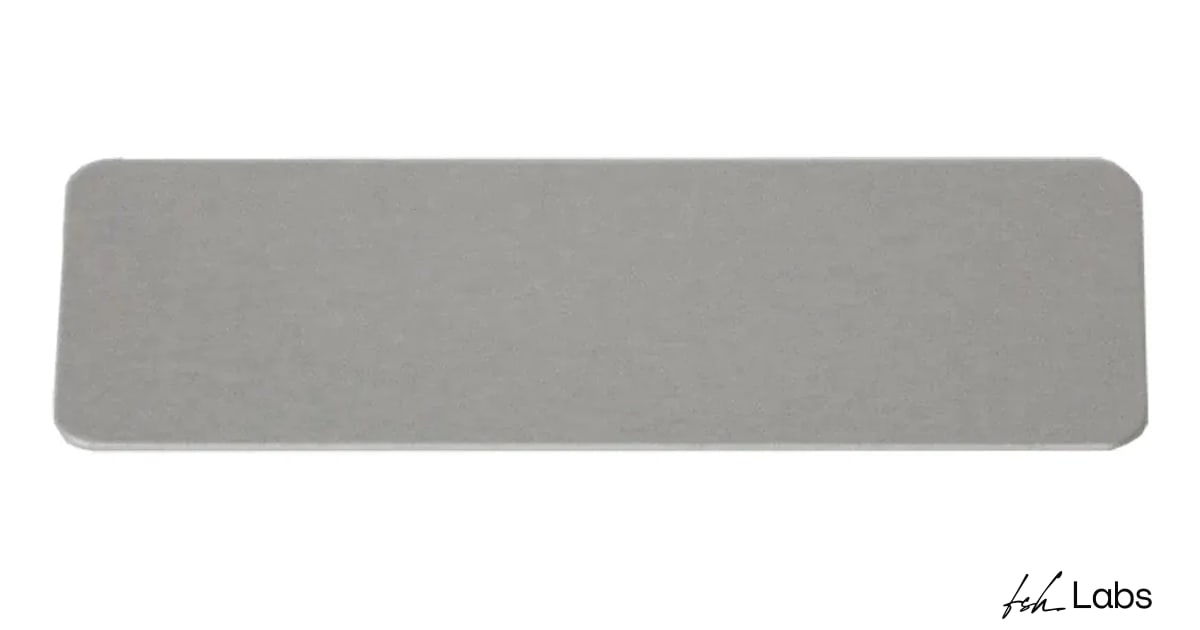
Laser engraved asset tags and valve tags that survive the plant floor
For an asset tag that survives the plant floor, start with metal and skip the printer. A fiber laser marks the number, the barcode and the logo into stainless steel or anodized aluminum, so the data is part of the surface instead of ink sitting on top of it. FSH Labs marks asset tags, valve tags and lockout tags in Mableton, GA, serves metro Atlanta, and ships anywhere in the US.
Key takeaways
- Printed polymer labels fail because the adhesive, the ink and the laminate each age differently. A laser marked metal tag has one surface and nothing to peel.
- Stainless steel suits wash-down, chemical and outdoor locations. Anodized aluminum is lighter and reads well indoors.
- Fiber laser marking handles serial numbers, QR codes and DataMatrix codes in one pass, so the human-readable and machine-readable data always match.
- Sequential numbering is easy because the laser writes each tag individually. There is no numbering die and no setup tooling.
- Asset tags, valve tags, lockout tags and panel labels all have price breaks at 1, 10, 25, 50 and 100 or more.
- Personalized items have no order minimum, and every order gets an emailed proof before production.
Why do printed labels fail on the plant floor?
A printed label is a stack of materials pretending to be one: release liner, adhesive, face stock, ink and often a laminate on top. Each layer responds to heat, oil, solvent and sunlight at a different rate. The adhesive creeps. The laminate lifts at a corner. The printed number fades after a few summers near a window or a few washes with a caustic cleaner.
The failure is rarely dramatic. You just stop being able to read tag 1147, and then the whole point of tagging is gone.
Fiber laser marking removes the layers entirely. The beam changes the surface of the metal itself, so there is no ink to fade and no laminate to peel. On powder-coated metal the laser removes the coating down to the steel, which is why a marked tumbler keeps its mark through the dishwasher.
Stainless steel or anodized aluminum?
Both work. The choice is about where the tag lives.
Stainless steel is the tougher option. It resists rust, handles repeated wash-down, stands up to most plant chemicals and does not care about ultraviolet light. If the tag goes on outdoor equipment, in a food or beverage area, or anywhere that gets hosed down, stainless is the safe pick. It is heavier, which matters if you are riveting hundreds of tags overhead.
Anodized aluminum is lighter, usually cheaper to ship, and the laser produces a crisp, high-contrast mark on the anodized layer. For indoor panels, racks, tool cribs and equipment rooms, it is more than enough.
A practical approach: stainless on anything that gets wet or washed, anodized aluminum everywhere else. If you are not sure, order a few of each and put them in the worst spot you have for a month.
How do serial numbers, QR codes and DataMatrix codes fit on one tag?
The marking field is 8.7 x 8.7 in, so a 1 x 3 in tag has plenty of room for several elements together. A typical asset tag carries a human-readable serial number, a short asset description, a QR code and sometimes a department or cost center.
Because the laser writes everything in one setup, the printed number and the encoded code come from the same data. That is the part people underestimate. With printed labels, a mismatch between the barcode and the human-readable number is a common data problem. When both are marked in the same pass from the same list, they cannot disagree.
QR codes are usually the better choice when a phone camera is the scanner. DataMatrix codes are denser and hold up better when the mark is small or the code carries a lot of characters. If you send the data, FSH Labs marks it. The asset tag page covers the format.
Can you do sequential numbering, even for a small run?
Yes. Sequential numbering is one of the simplest things about laser marking. You send the list after checkout, and each tag is marked with its own number. There is no numbering die, no stamping machine and no minimum quantity of identical tags.
That is also why small runs stay affordable. With no die and no screen to make, a run of 10 costs the same per unit whether the numbers are sequential or random. Price breaks start at 1, then 10, 25, 50 and 100 and up, so the per-tag price drops at each step.
Being able to extend a series matters too. If you start at A-1001 this year and need A-1201 next year, the mark looks the same and there is nothing to retool.
Valve tags work the same way. They are 1.5 in round in brass or stainless steel, with a hole for a chain or an S-hook, numbered from your list. Brass has the traditional look many plants expect on a valve. Stainless is the choice for wet or corrosive service. See valve tags for finishes and pricing.
One practical way to justify the switch from printed labels is to order a small batch, put them where the printed ones failed, and compare after a few months.
What about lockout tags?
A paper lockout tag is a one-shift object. Write on it once, spill oil on it, and it is done. A metal lockout tag carries the worker's name, department or a photo and keeps going for years.
Lockout tags come in 1.5 x 3 in stainless or black aluminum, and 2 x 3 in red anodized aluminum, each with a hole for the lock. Red is the conventional lockout color and reads from across the aisle. Stainless suits outdoor or wash-down equipment. The lockout tag page lists the finishes.
One thing to plan: because the tag is specific to a person, a department or a piece of equipment, decide the format before you order. Names change. If you expect turnover, a department name plus a tag ID often outlasts an individual's name.
Do panel labels and breaker labels belong here too?
Yes, though they are a different animal. Panel labels are engraved two-ply plastic, 1 x 3 in with adhesive on the back, made for breakers, panels and controls. The engraving cuts through the top color to reveal the second color, so the text is part of the plastic rather than printed on it.
They are not metal and they are not built for wash-down. For an electrical room, a control cabinet or a machine panel, they are the clean, readable choice, and they are ready faster than the metal tags at 2 to 3 business days. Other sizes are available on request.
The wider point is that not every label in a plant needs the same material. Match the tag to the environment and the budget stops fighting the durability. The fiber laser marking service covers the metal side, including replacement nameplates matched from a photo of an old plate.
Ordering from FSH Labs
Send your list: tag numbers, any descriptions, and the code format if you want QR or DataMatrix. If you are not sure which material fits, tell us where the tag goes and what it gets exposed to.
Start at the asset tag page to order, or call 678-210-6694 or email chaz@fshlabs.com with questions. Hours are Monday to Saturday, 9 am to 3 pm Eastern, closed Sunday. Blanks for metal tags are ordered after you pay, so they ship in 5 to 7 business days. Free pickup in metro Atlanta by arrangement, and shipping anywhere in the US.
FAQ
- How much do laser engraved asset tags cost?
- Asset tags run $6 each at 1 or more and drop to $1.60 each at 100 or more. Valve tags, lockout tags and panel labels have their own price breaks, listed on each product page.
- What is the lead time on metal asset tags?
- Metal tags ship in 5 to 7 business days. Blanks are ordered after you pay, so the clock starts at checkout. Engraved plastic panel labels are ready in 2 to 3 business days.
- Can you mark a QR code and a serial number on the same tag?
- Yes. A 1 x 3 in tag has room for a human-readable number, a short description and a QR or DataMatrix code. Both the number and the code are marked in the same pass.
- Do I need to order hundreds of tags?
- No. There is no tooling to pay for and personalized items have no order minimum, so a run of 10 works. Price breaks start at 1, 10, 25, 50 and 100 or more.
- Which material is better for outdoor or wash-down equipment?
- Stainless steel is the better choice where a tag gets wet, washed or exposed to chemicals. Anodized aluminum works well indoors and is lighter.
- Can you number the tags sequentially from my list?
- Yes. Send your list after checkout and each tag is marked with its own number. You can extend the same series later and the marks will still match.