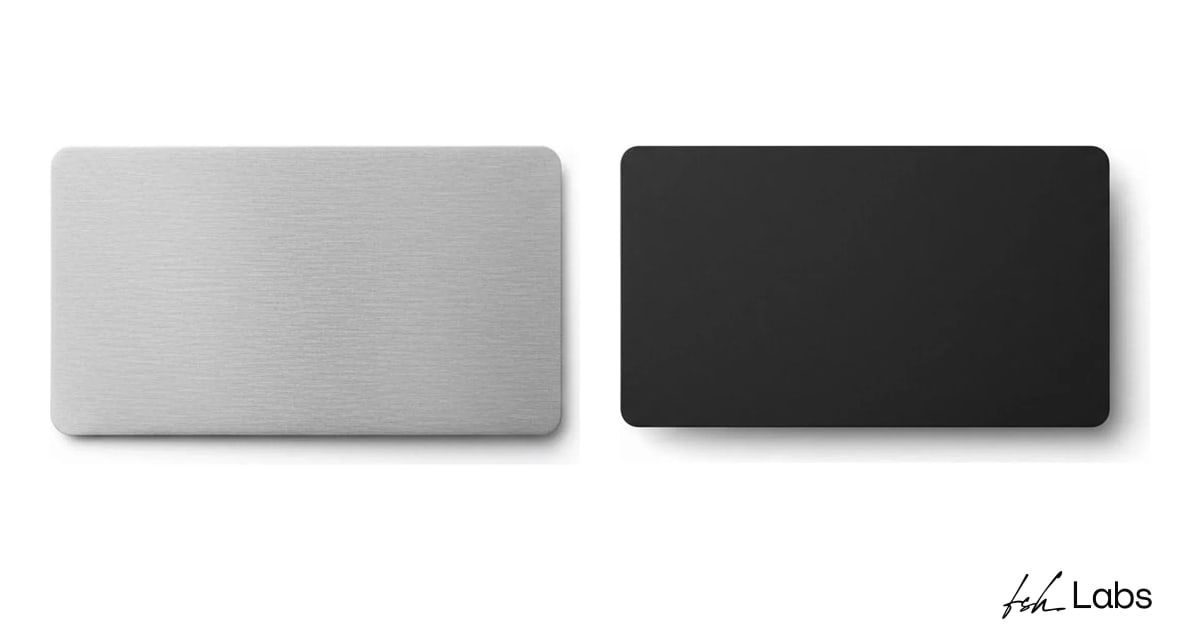
Metal business cards Atlanta: worth it, and how they are made
Yes, metal business cards can be worth it when the card needs to survive a pocket, a job site or a follow-up weeks later. For most buyers in metro Atlanta, the decision comes down to finish, readable design and quantity. Here is how we make them at FSH Labs and when the upgrade makes sense.
Key takeaways
- Standard metal cards are 3.4 x 2.1 in, credit card size, in 0.5 mm stainless steel or black-coated stainless.
- Fiber laser marking is permanent. It marks the metal; it does not rely on ink.
- Bare stainless has an industrial look. Black-coated stainless gives stronger contrast but shows wear more.
- Simple, high-contrast layouts read best. Tiny type and fine logo lines are the usual problems.
- QR codes can be marked directly on metal, but they need a test scan before the full run.
- Standard cards are $6 each at 1+, $4.50 at 10+, $3.50 at 25+, $2.75 at 50+ and $2.25 at 100+. There is no order minimum on personalized items.
Are metal business cards worth it?
A metal card is not the cheapest way to hand out your name. It is a keepable object. Paper cards get bent, rained on and thrown away. A stainless card can sit in a wallet for a long time and still look like something.
That matters when the card is doing real work. A sales team meeting qualified prospects, a realtor leaving something after a showing, a trade professional meeting a plant maintenance lead or a church volunteer representing a ministry all need the card to stay around. Metal gives people a reason to hold on.
It makes less sense for a huge, casual handout. If you expect most cards to be discarded, paper is the smarter spend. Metal is best when you want fewer, better cards. We mark them in Mableton and ship anywhere in the US.
Stainless or black: which finish should I choose?
Bare stainless is the industrial choice. It looks like metal because it is metal. The mark usually reads as a darker tone against the raw surface. It suits contractors, maintenance teams, makers and brands that should feel practical. It can show fingerprints and fine scratches, but those marks tend to blend in.
Black-coated stainless is the higher-contrast choice. The mark shows as a lighter tone against the black surface, and logos can look more like a premium brand piece. The tradeoff is that scratches or wear in the coating are easier to see. If the card lives in a wallet or badge holder, that is usually fine. On a dirty job site, bare stainless is more forgiving.
Our standard card comes in Stainless or Black. See the options and order at metal business cards. For a team, carry one sample for a week before ordering the batch.
Marked or etched: what is the difference?
Buyers use etched, engraved and marked almost interchangeably. For metal cards, we use fiber laser marking. The laser creates a permanent mark on the surface. It is not ink, so it does not wash off or rub away like a printed card.
It is a surface process. It does not change the card's size or shape. The detail to watch is contrast. On bare stainless, the mark is usually darker than the metal. On black-coated stainless, the mark changes the coating to create a light mark. Both can look excellent, but they do not look the same. Ask for a proof on the finish you are considering.
Read more on our fiber laser marking page.
What details read well at card size?
A metal card is 3.4 x 2.1 in, which is credit card size. That is slightly smaller than a standard 3.5 x 2 in paper card. You do not have room for a paragraph.
Put the essentials on the front: name, role, company, phone and email. Put supporting details on the back: logo, website, a short tagline and a QR code if you want one. If a trade license or service category matters, put it in plain text.
Use high contrast and generous spacing. Keep body text at least 7 point if you can. Avoid thin logo lines; they can fill in or disappear at small sizes. A simple logo marks better than a detailed illustration. Use one phone number and one email, not three of each.
For a sales team, make the next step obvious. For a realtor, connect the name to a listing. For a plant maintenance lead, make the service and contact path clear. For a church volunteer, a name and role may be enough.
Do QR codes work on metal?
Yes. Fiber laser marking can mark QR and DataMatrix codes directly on stainless and black-coated stainless. The code is part of the surface, so it will not peel off like a sticker.
The catch is contrast and size. A QR code needs a clear quiet zone and enough contrast for a phone camera. On bare stainless, the mark may be lower contrast than you expect. On black-coated stainless, it usually stands out more. Test scan the proof with a few phones before you approve the batch.
Use a short link. For a sales team, send people to a booking page. For a realtor, a listing. For a trade professional, a quote request. Put the code where a wallet will not rub it.
When do metal cards make sense?
They make sense when the card is part of the sale, not just a formality. A sales team meeting a small number of high-value prospects can use metal to stand out. A realtor can leave one after a showing. A trade professional can hand one to a plant maintenance lead who will keep it in a desk drawer or toolbox.
They also work for teams that want a consistent, durable piece. At 10, 25 or 50 cards, the price breaks help. A church volunteer or office manager may only need a small batch, and there is no order minimum on personalized items. That makes it easy to try a few first. A bride ordering a small keepsake run or someone buying a gift can order just one.
They make less sense when volume and low cost are the only goals. For a mass handout where most cards will be thrown away, paper is still practical. Metal is for moments when you want the card kept.
What does quantity pricing look like?
Standard metal cards are $6 each at 1+, $4.50 at 10+, $3.50 at 25+, $2.75 at 50+ and $2.25 at 100+. There is no order minimum on personalized items.
Because blanks are ordered after you pay, lead time is 5 to 7 business days. Every personalized order gets an emailed proof before production. That proof is the time to catch a misspelled name, a wrong phone number or a logo that is too fine for the finish.
Compare cost per card that actually gets kept. A $6 card that stays in a wallet for a year can be a better buy than a stack of paper cards that end up in the trash. See the full range at personalize or go straight to metal business card.
Ordering from FSH Labs
Start on the metal business card page. Choose Stainless or Black, pick your quantity and send your logo or artwork. We will email a proof before production. Once you approve and pay, the blanks are ordered and the cards are marked.
We are in Mableton. Pickup is available by arrangement at a meeting spot in metro Atlanta, and we ship anywhere in the US. Hours are Monday to Saturday, 9 am to 3 pm Eastern. If you are unsure about the finish, order one sample first.
FAQ
- Are metal business cards worth the cost?
- They cost more than paper, but they last and tend to get kept. For roles where the card is a first impression, the extra cost per card is small compared with the cost of being forgotten.
- Can you put a QR code on a metal business card?
- Yes. Fiber laser marking can mark QR and DataMatrix codes directly into stainless or black-coated stainless. Keep the code large enough and test-scan a proof before the full run.
- Do metal business cards scratch?
- Stainless is tough, but the surface can still show wear over time. Black-coated cards show scratches more than bare stainless, so choose the finish for the look you want.
- How long does an order take?
- Standard metal business cards take 5 to 7 business days because blanks are ordered after you pay. Every personalized order gets an emailed proof before production.
- What is the minimum order?
- There is no order minimum on personalized items. You can order one card or a hundred, and price breaks start at 10, 25, 50 and 100+.