Replacement nameplate engraving: how to restore a worn data plate
A worn nameplate is easy to ignore until a buyer, an inspector or a new technician needs the data on it. Replacement nameplate engraving starts with the old plate, not a blank one: photograph it, measure it, and note how it mounts. FSH Labs is a laser shop in Mableton, GA that marks replacement nameplates and data plates on anodized aluminum and stainless steel, matched from a photo of the plate you send.
Key takeaways
- Fiber laser marking is permanent on metal. There is no ink or laminate to rub off.
- A straight-on photo of the old plate plus width, height and hole spacing is enough to start.
- Anodized aluminum gives the sharpest contrast for data plates. Stainless steel resists chemicals and abrasion better.
- Plan on 5 to 7 business days. Blanks are ordered after you pay.
- Every order gets an emailed proof before production, so a wrong serial gets caught early.
- Equipment nameplates are $15 each at 1+, dropping to $5 each at 100+.
Why do motor, pump and equipment plates fade?
Most plates fade for boring reasons. Sunlight, coolant splash, washdown chemicals and years of handling break down printed ink and adhesive. Printed and laminated plates usually lose contrast at the edges first, right where the serial number sits. Cleaning pads and dropped tools add scratches on top of that.
Anodized aluminum holds up better than a printed label, but it is not immune. Abrasion still dulls the surface over time. The difference with fiber laser marking is that nothing sits on top of the metal to wear off. The laser changes the surface itself, so the text does not peel or flake the way ink does. Once the serial or the amp rating is unreadable, the plate stops doing its job, and that is when a replacement makes sense.
What information do I need to capture from the old plate?
Photograph the plate straight on in good light, and take a second photo of the back so the mounting is clear. Then write down:
- Every line of text, in order, including abbreviations and units.
- Model number, serial number and part number, character for character.
- Ratings: voltage, amperage, horsepower, RPM, flow, pressure, temperature, refrigerant.
- Any logo, and whether it is a solid mark or an outline.
- Overall width and height, and the thickness if you can measure it.
- The center-to-center distance between mounting holes and the hole diameter.
- Whether the plate is flat and where it sits on the machine.
If part of the plate is gone, say so. A readable model number plus the machine type is often enough to fill the gap. Anything you are unsure about, leave for the proof stage instead of guessing.
Anodized aluminum or stainless steel?
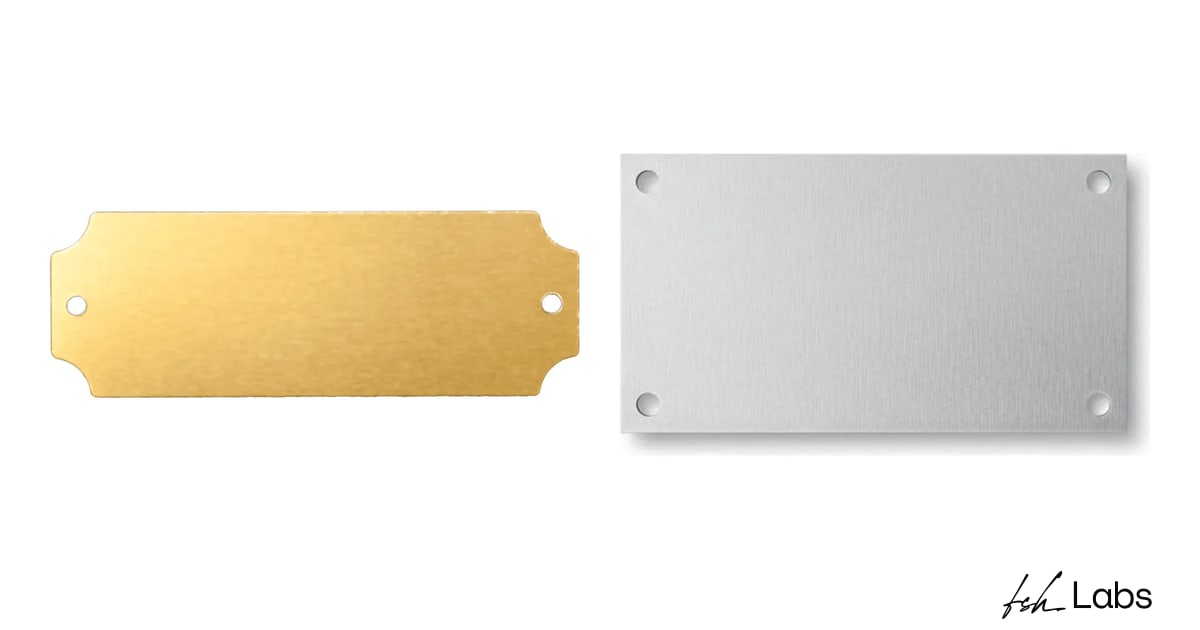
Anodized aluminum is the usual choice for data plates. The mark comes out with strong contrast against the anodized surface, which is what you want when someone is reading a serial number in poor light. The standard equipment nameplate is about 3 x 1.5 inches in anodized aluminum, in a brass finish or silver.
Stainless steel is the tougher option. It shrugs off chemicals, salt air and repeated scrubbing better than aluminum. If the plate lives outdoors, near a washdown station or in a plant with aggressive fumes, stainless is worth considering. Both metals are marked on the same fiber laser, so the choice is about the environment, not the process. For a stainless plate in a tag format, the stainless tag is 2 x 1.1 inches with a split ring. The fiber laser marking page covers what the process can and cannot do on metal.
Can you match a plate from a photo?
Yes. Send a clear photo of the old plate, along with the measurements and the text you need. The layout gets rebuilt line by line, including the logo and the spacing between fields. You get an emailed proof before anything is marked. Check the proof carefully, especially serial numbers, model numbers and units. That is the moment to catch a transposed digit.
Some buyers need the replacement to look like the factory plate, and some just need the data legible. Both are fine. If the plate is on an older machine and the original lettering matters, include a close photo of the text so the proportions can be followed. If the goal is a clean, readable plate for a maintenance file or an insurance record, the standard layout works.
How do hole patterns and mounting work?
Plates come drilled or with an adhesive back. If the old plate was riveted or screwed on, send the center-to-center hole spacing and the hole diameter so the new plate lines up with the existing holes. If the old plate used adhesive, an adhesive back is the simplest swap. Note that the mounting surface needs to be flat. If the spot is curved or recessed, mention it when you order so the plate can be planned around it.
Can I order small runs with serial numbers?
Yes. Asset tags are 1 x 3 inches in lacquered aluminum, numbered in sequence, with a barcode or QR code if you want one. Send your list after checkout, one number per line. Pricing is $6 each at 1+, $3.50 each at 10+, $2.50 each at 25+, $2 each at 50+ and $1.60 each at 100+.
For valves and round equipment tags, valve tags are 1.5 inches round in brass or stainless steel with a hole for a chain or S-hook. Those run $7 each at 1+, $5.50 at 10+, $5 at 25+, $4.50 at 50+ and $4 at 100+. Mixing formats across one serial list is common on a plant walkdown, so send the whole list in one file and split it by type.
There is no order minimum on personalized items, so a single plate is not a problem. For a one-off plate on a small part, the equipment plate page has the size and finish details. If you are weighing a marked metal plate against an engraved plastic one, what drives the price explains how material and run length change the cost.
Ordering from FSH Labs
Start with the replacement nameplate page. Send a photo of the old plate, the measurements and the text you need, or call 678-210-6694 or email chaz@fshlabs.com. You will get a proof to approve, then production runs 5 to 7 business days from payment because the blanks are ordered after checkout. Orders ship anywhere in the US, and free pickup in metro Atlanta is available by arrangement. Hours are Monday to Saturday, 9 am to 3 pm Eastern.
FAQ
- Can you match a nameplate from a photo of the old plate?
- Yes. Send a straight-on photo in good light, plus the width and height of the plate. The layout gets rebuilt from the photo and you approve an emailed proof before production.
- How long does a replacement nameplate take?
- Plan on 5 to 7 business days. The blanks are ordered after you pay, so the clock starts then.
- Should I choose anodized aluminum or stainless steel?
- Anodized aluminum gives the sharpest contrast for reading a serial number in poor light. Stainless steel resists chemicals and abrasion better for outdoor or washdown locations.
- Can I order serial numbers in sequence on a small run?
- Yes. Send your list after checkout, one number per line. Asset tags can include a barcode or QR code, and there is no order minimum on personalized items.
- What do I need to measure on my old plate?
- Measure width and height, the center-to-center distance between mounting holes and the hole diameter. A photo of the back makes the mounting style clear.
- What does a replacement nameplate cost?
- Equipment nameplates are $15 each at 1+, dropping to $10 each at 10+, $7 each at 25+, $6 each at 50+ and $5 each at 100+.