Bible name engraving in Atlanta: how it works and what can go wrong
You can get a name laser engraved on most Bibles by sending the Bible itself to a shop that checks the cover first, or by ordering a leatherette Bible cover with the name already on it. In metro Atlanta, FSH Labs does both from Mableton, with a proof before anything touches the laser. The main thing that goes wrong is the cover material, so that is where to start.
Key takeaways
- Genuine leather and most imitation leather covers engrave well. Some covers are vinyl, and vinyl cannot go on a laser.
- A laser darkens the cover instead of adding gold, so expect a tone-on-tone mark, not a shiny one.
- The lower right corner of the front cover is the classic spot for a name, initials or a short line.
- Send a typed list of names, not a photo of a roster. Typed lists keep every spelling right.
- A Bible you send in is ready 3 to 5 business days after it arrives. A leatherette cover takes 5 to 7 business days.
- If you are not sure what your cover is made of, a leatherette Bible cover takes the guesswork out.
What kind of cover does my Bible have, and does it matter?
It matters more than anything else. Publishers use a lot of names for cover materials, and the name on the box does not always tell you what the cover is.
Genuine leather. Top-grain, cowhide, calfskin and goatskin covers are the easy case. The laser darkens the leather where it marks, so the name reads like it came from the publisher. Lighter leathers show the most contrast.
Bonded leather. This is leather fiber pressed together with a binder and usually coated on the surface. It often engraves fine, but the coating can react differently from real leather, and results vary from one publisher to the next. It is worth checking before you commit a stack of them.
Imitation leather. Covers sold as LeatherSoft, LeatherTouch, TruTone and similar names are usually polyurethane, and most of them engrave well. The catch is that a few imitation covers are vinyl. Vinyl gives off harmful fumes under a laser and is not safe to engrave, so the answer for those is no.
Hardcover and cloth. Printed hardcovers and cloth-wrapped covers are a different surface entirely. They are a case-by-case question, so ask before you order.
The simple way to avoid a surprise is to tell the shop the exact Bible: a link to the product page, or the publisher, translation and cover name printed on the box. FSH Labs checks that the cover can be engraved before starting.
Laser engraving or gold foil: which is better?
Neither is better everywhere. They do different things.
Hot-foil stamping presses a thin metallic film into the cover with a heated die. It is what most Bible bookstores use, and it is the only way to get a gold or silver name. On a black cover, foil gives you strong contrast. The downside is that foil sits on the surface, and on a Bible that gets carried every week it can wear and flake at the edges over the years.
A laser does not add anything. It changes the cover itself, darkening leather or marking the surface of imitation leather. That means there is nothing to peel off, and the mark lasts as long as the cover does. It looks closer to a debossed, tone-on-tone mark than to gold lettering.
Where the laser wins:
- Genuine leather in brown, tan or burgundy, where the darkened name has real contrast.
- Bibles that see heavy daily use, where foil would wear.
- Groups where every Bible needs a different name, since there is no die to make for each name.
Where foil wins:
- When you specifically want gold or silver letters.
- When you want high contrast on a black cover. A laser on black gives a subtle mark, which many people like, but it will not pop.
- Vinyl covers, which a laser cannot touch.
If you want shiny gold, a laser is the wrong tool and you should go to a foil stamper. If you want a mark that will not wear off, a laser is the right one.
What font and placement work best?
Keep it simple, and keep it small enough to look like it belongs there.
Placement. The lower right corner of the front cover is the traditional spot. It is where the eye expects a name, and it stays clear of the publisher's title and any border stamping. A centered name near the bottom also works. Leave a comfortable margin from the edges and stay off the spine side, where the cover flexes.
What to put there. A full name, initials, or a short line. A date or a verse reference under the name is fine and works well for a baptism or a graduation. Long verses belong on a cover with more room, not crammed into a corner.
Fonts. Classic serif faces and clean script both suit a Bible. A few things to watch:
- Very thin script strokes can fill in and blur at small sizes. Pick a script with some weight to it.
- All caps in a serif face reads formal and clean, which suits a pastor or an ordination gift.
- One font is almost always enough. Two at most, such as a script name with a small serif date underneath.
If you do not have a font in mind, ask for a few options. FSH Labs sends mockups so you can choose, then a proof of the final layout. Read the proof slowly, letter by letter. A spelling mistake engraved into leather is permanent.
Should I send my own Bible or order a leatherette cover?
Both are good answers. It depends on what you are giving.
Send your own Bible when the gift is a particular Bible: a specific translation, a study Bible, or one the person already carries. You can ship it or hand it off at a meeting spot in metro Atlanta. It is ready 3 to 5 business days after it arrives. Pricing and the full process are on the Bible engraving page.
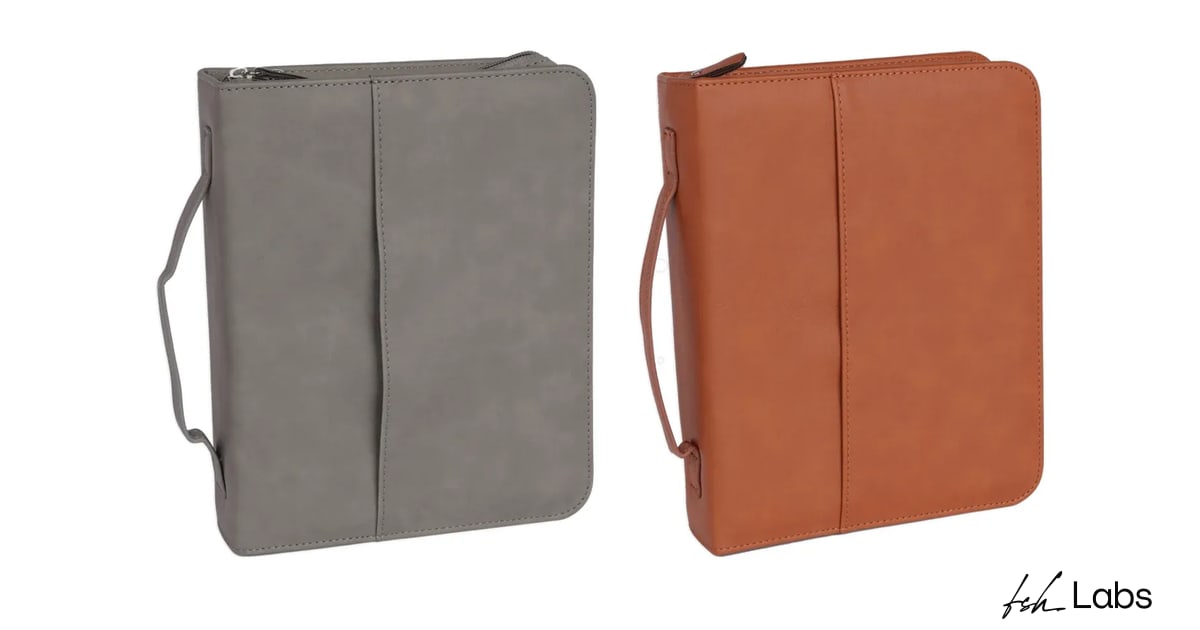
Order a leatherette Bible cover when you want a sure result without worrying about the cover material, or when the Bibles themselves come from different places. The leatherette Bible cover is a zippered cover with a handle that fits most standard Bibles, in Iron grey or Chestnut, with a name or verse engraved on the front. It is $38 for one, with price breaks for groups down to $26 each at 100 or more. Lead time is 5 to 7 business days, since the blank covers are ordered after you pay.
A cover is also a good choice for a Bible you would rather not mark directly, such as an heirloom or a gift with a cover type you cannot confirm.
Is a personalized Bible a good gift for a baptism, graduation or ordination?
It is one of the most kept gifts there is, which is the reason to get the details right.
- Baptisms and dedications. A name and the date is the classic layout. Make sure you have the exact spelling the family uses, including middle names.
- Graduations. Seniors, confirmation classes and VBS volunteers each get their own name. Send the list early, since a graduation date does not move.
- Ordinations and pastors. A formal serif name, sometimes with a title or a verse reference, on a cover that will be carried for years.
For any group, engraving costs the same per Bible as one, and each name is checked against your list before it goes on the laser. If you have a date to hit, say so when you order and the schedule is planned around it.
What else can go wrong, and how do I avoid it?
Most problems come from three places.
- The wrong cover material. Tell the shop the exact Bible before you buy twenty of them.
- Spelling. Send a typed list, one name per line, exactly as each should read. Check the proof against the list.
- Timing. Allow the lead time plus shipping. If the Bibles are shipping to the shop, count the days they spend in transit too.
If you have other flat items to personalize for the same event, such as journals or leather goods, see engraving your own items.
Ordering from FSH Labs
Start on the Bible engraving page. Tell us the Bible, the names and the date you need them, and a person replies within 24 hours. If you would rather skip the cover question, order a leatherette Bible cover online. Either way, you see a proof before anything is engraved, and you can pick up in metro Atlanta or have it shipped anywhere in the US.
FAQ
- Can any Bible be engraved with a name?
- Most can. Genuine leather and most imitation leather covers engrave well, but some covers are vinyl, which cannot go on a laser safely. FSH Labs checks the exact Bible before engraving anything.
- Is laser engraving the same as gold foil stamping?
- No. Foil stamping presses a metallic film into the cover. A laser darkens the cover material itself, so there is no foil to flake off, and the result looks like a tone-on-tone debossed mark rather than gold.
- How long does Bible name engraving take at FSH Labs?
- For a Bible you send in, plan on 3 to 5 business days after it reaches the shop. A leatherette Bible cover from the catalog takes 5 to 7 business days, because the blank covers are ordered after you pay.
- Where on the Bible should the name go?
- The usual spot is the lower right corner of the front cover. A name, initials or a short line works best there, with a date or verse reference under it if you want one.
- Can every Bible in a group get a different name?
- Yes. Send a typed list with one name per line, exactly as each should read, and every Bible gets its own name.
- Will I see the design before it is engraved?
- Yes. You get mockups to choose a design, then a proof of the final layout, and nothing is engraved until you approve it.